The red flags are public.
They're just in Korean.
Korean stocks announce their own risk — dilutions, capital reductions, embezzlement or breach-of-trust filings —
in mandatory filings, years before the damage. If you can't read Korean, that early warning simply
doesn't reach you. We fix exactly that.
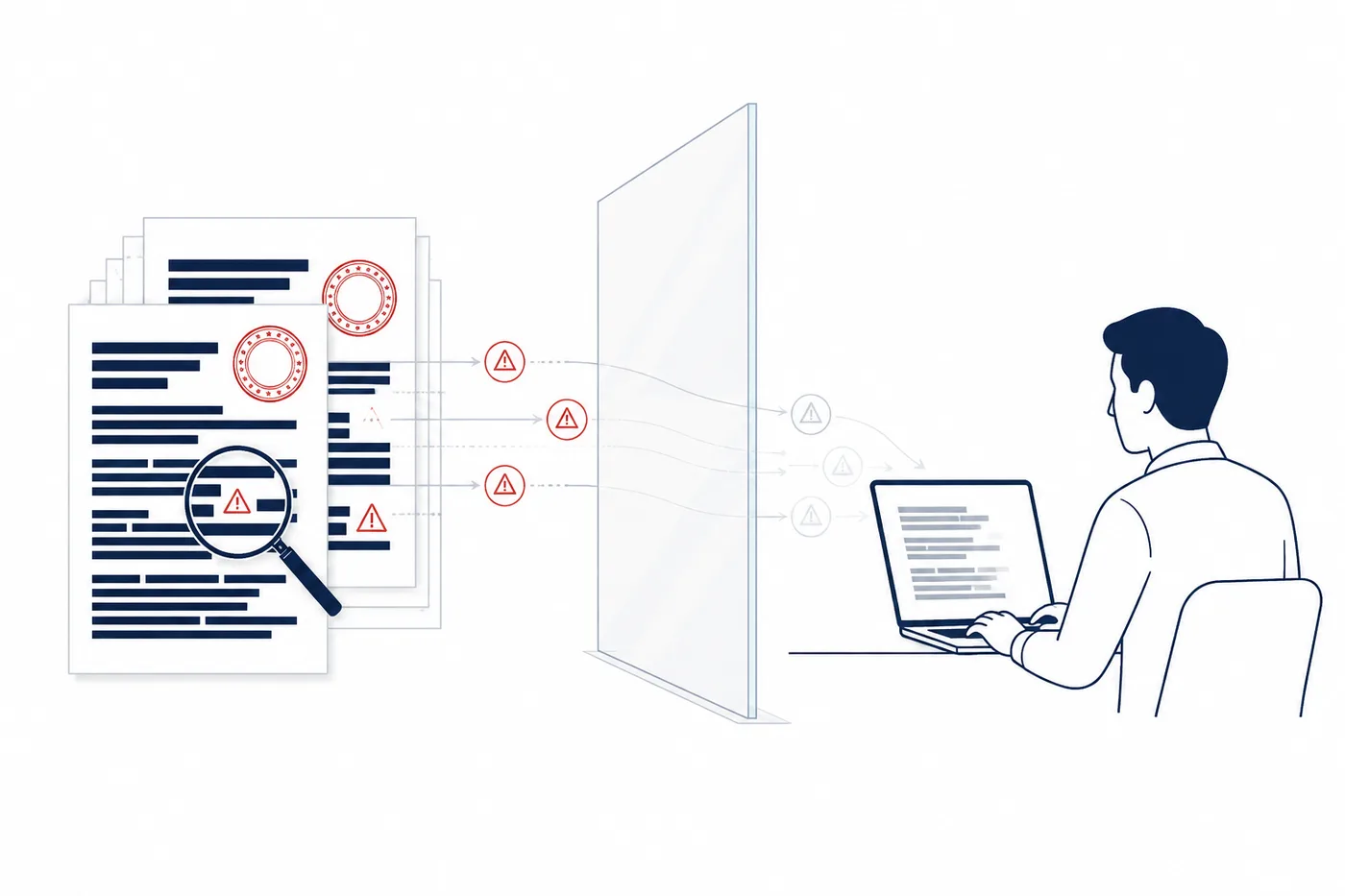
01 · THE PROBLEM
"Upload the annual report." Which one?
Korean listed companies file on DART, Korea's central corporate disclosure system. The authoritative filing is in Korean, and mandatory English coverage remains partial.
For most of 2,650 listed companies there is no English annual report, no English earnings-call
transcript, often no English IR page at all. Translation apps give you words, not filing types:
a 유상증자 filing is a decision to raise paid-in capital, and whether existing shareholders are diluted depends on the allocation method.
So the research base you build for a Korean stock has a hole exactly where the risk lives —
the filings you can't read.
02 · WHY IT MATTERS
The pattern shows up before the damage
Serial dilution — convertible bonds, share issuances, capital reductions — appears in filings
years before a stock is delisted for cause. We rated every listed company on the filings available
at the time, then tracked what the KRX actually did next:
42.1%
of companies with our highest risk rating were later delisted for cause
10×
the market's average delisting rate — measured on past outcomes, not a prediction
The arithmetic. Those numbers are measured on past filings — a historical rate,
not a prediction about any stock. Membership is $9 a month at launch — the price of knowing
what a company has actually filed, in a language you can read.
Validation table and limitations: Method.
03 · NOT REAL-TIME. ON TIME.
Why a nightly alert beats a live ticker
- Many risk-relevant filings arrive after the Korean market close. In a typical week, about 4 out of 5 risk filings
land after 15:30 KST, once the market is already shut. Our nightly read covers the full day's filings —
so the alert is in your inbox before Korea opens again, and with your morning coffee if you're
in the US.
- A price move tells you that something happened — not what. When your stock is
down 8%, we hand you the reason: "a share issuance, its 6th in three years — here's the filing."
Price charts show the market reaction. Filing history shows what the company disclosed.
- The most dangerous filings don't move the price that day. A convertible bond here, a sanction
warning there — they barely dent the chart, then they stack. If you only watch the price, the first day
you notice is the last day it matters.
- "Early" has two clocks. On a single filing we are hours behind real time. On the filing
pattern, the record can build for years: Soribada sat at the top of our filing-risk scale for four years
before it was delisted.
04 · WHAT WE DO
We read the filings so your workflow doesn't break
- Watchlist alerts — when a stock you hold files something that matters, it lands in your
inbox the same evening (KST), before the next Korean open. Quiet by design: most days, nothing.
- A company filing report per company — risk score, dilution history, critical filings
(embezzlement or breach-of-trust filings, audit issues), every claim linked to the original DART document.
- An AI connector key — plug our data straight into Claude. Your research
workflow stays the same; the Korean evidence hole closes.
429,701 filings from listed companies, tracked since 2011, refreshed daily.
05 · WHO IT'S FOR
Foreign investors buying Korean stocks directly
If you buy KRX stocks through IBKR or a local broker and you can't read Korean filings,
the disclosure record that gives that context is not available to you in a language you can read.
What you get for $9/mo: the report for any of 2,650 companies, alerts on your
watchlist, and the AI connector key — cancel anytime, no questions asked.
 KoreaStockCheckBACKGROUND CHECKS · KRX FILINGS